>>Cliquez ici pour la version française<<
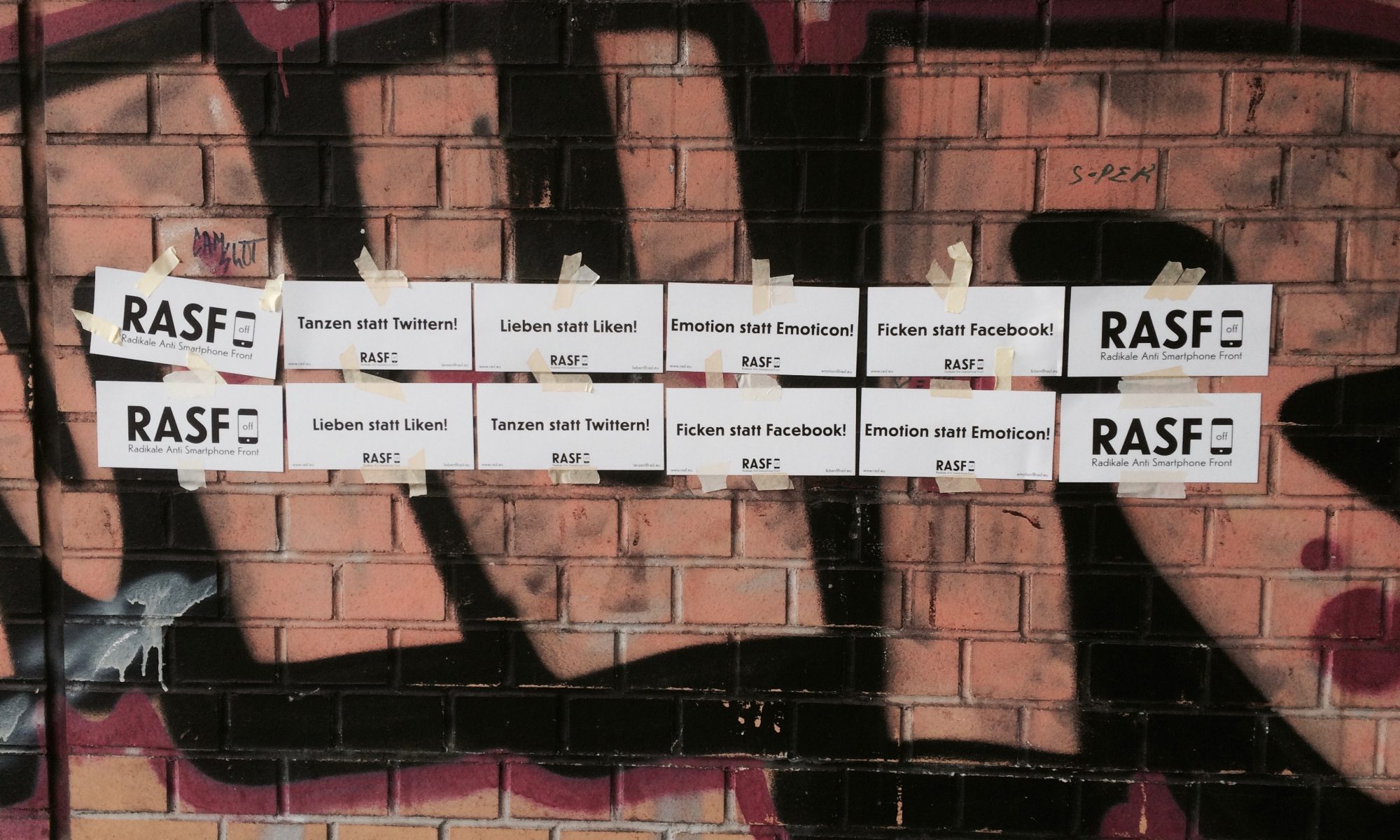
The world is changed. Digital media are transforming our lives more profoundly than any other innovation in the past century. Smartphones have penetrated the most remote corners of our lives and turned many areas of our daily routine upside down. Nowadays, we can easily navigate to remote locations, access the world’s collective knowledge via search engines and maintain contact with our friends on social networks, even if they live on the other side of the planet. And in the future, too, global networking will remain the source of technological progress, and no problem seems too big to be solved by the new prophets from Silicon Valley. But does watching cat videos while dining out with the family really improve our quality of life? Are you part of the social avant-garde if you can stage the illusion of a happy and fulfilled life on social networks, even though it is based on lies and self-deception? Does our society become a more liveable place when our public sphere becomes increasingly fragmented until everyone has comfortably settled into their personalised digital bubble and is no longer accessible to the problems and concerns of people who think differently? We at the Radical Anti Smartphone Front clearly say: NO! No to parallel communication with absent people in the presence of others, no to the self-expression of our own narcissism, and no to the continuing drifting apart of our society! And we clearly say NO to the excessive use of smartphones, which is gradually poisoning our social lives. Instead, we say YES to everything that makes our lives truly worth living: friendship, freedom, love and solidarity. Our credo is therefore: Exit Social Media! Regulate Big Tech! Stop Digital Dystopia! We are the Radical Anti Smartphone Front!
More important than a horde of followers on Facebook are a handful of friends with whom we can laugh, cry and talk about the important things in life. But more people prefer to surf the internet instead of cultivating friendships in the analogue world. Of course, we can also be close to our friends on social networks, and we can stay in touch with more people than ever before. However, we must always know there is a tension between the quantity and quality of friendships. We can send a message to our friends in Amsterdam, New York, Hoyerswerda and Buxtehude at any time via WhatsApp, but we don’t realise that we are not paying attention to our immediate surroundings. Researchers from the Mental Balance project found that smartphone users switched on their devices an average of 88 times a day, 35 times to check the time or their messages and 53 times to surf the internet, chat or use apps. This means that the participants in this project focused their attention on their smartphones every 18 minutes of their waking hours and spent two and a half hours a day on their smartphones – only 7 minutes of which were spent making phone calls. Whether at restaurants, in bars or during sex, everyone sometimes finds it annoying when their friends or partner are glued to their smartphones. According to the W3B study, 74% of all internet users say that everyday life would be more pleasant if more people turned off their smartphones from time to time. So, it would be better if we remembered more often to enjoy the moment with our friends here and now, instead of constantly focusing our attention on the screen.
This constant distraction and the constant search for the next stimulus led to an absence of boredom. Whether it’s checking WhatsApp messages, football results, the latest fashion trends or the newest conspiracy theories, there is always something to grab our attention. As soon as we are confronted with even the slightest hint of boredom, we routinely reach into our pockets and read something that we will have forgotten again in five minutes. As a result, we passively follow the lives of others from the role of spectators, instead of becoming active and taking matters into our own hands again. After all, if you’re not bored, you won’t get creative, explore new avenues or develop thoughts that are longer than 140 characters.
What’s more, social networks are gradually degrading life to a shop window and transforming the world into a shopping mall where everyone displays their wares, but no one buys anything anymore. The currency of this world is called LIKE. Although you can’t buy anything with it, for most digital natives, having lots of likes on their social media presence is now more important than status symbols that can be bought. After all, they mean attention and recognition for us and our achievements. Therefore, they also define our social status, determine our well-being and, in some cases, even develop into an addiction. Quite a few of us already get sweaty palms as soon as our smartphone battery runs low and there is no charger in sight.
Furthermore, there is fierce competition for this currency, so that the battle for attention increasingly determines our actions. Anyone who goes on holiday to tourist hotspots these days no longer knows whether some people are photographing what they experience or experiencing something to photograph it. Because the most important means in the hunt for likes is multimedia self-expression at all levels. But when staging one’s own life takes the place of living it, this has fatal consequences for the individual and society, because constant comparability is a battle in which there are hardly any winners.
Among young people in particular, social networks lead to a high pressure to conform, which in many cases even results in mental illness. According to the Robert Koch Institute (2016), the proportion of young girls with eating disorders has increased from 20% to 35% in the last five years. Under #fitness, Instagram has around 100 million pictures of boys and girls documenting how they are becoming slimmer and more muscular. This flood of selfies, combined with Heidi Klum’s stick-thin principle, acts like a gateway drug for many young people. A drug that can have fatal and long-term consequences.
In addition, smartphones create a personalised digital bubble for each user, further fragmenting our public sphere and polarising society. Nowadays, much of our information is obtained through digital media, especially smartphones. However, on the internet, we only read what we are looking for and not the things we didn’t even know we were interested in. After all, we tend to read articles that confirm our opinions rather than challenge them. Especially on social media, we are only served what we statistically like, and the public sphere thus created is characterised by uniformity rather than diversity. For example, when British internet activist Tom Steinberg searched his social media timeline for people who welcomed Brexit, he did not find one, even though 52% of the population had voted in favour of it. The exchange of opinions, which is essential for public discourse, is therefore taking place less.
These media echo chambers also lead to declining tolerance for other opinions and thus to increased aggression in political debate. This fact can be observed above all in the inflationary use of the term „fake news“, because for many people with right-wing views, the reporting of the so-called mainstream media no longer corresponds to the virtual reality on social networks. Those who are against accepting refugees are highly likely to see many people in their Facebook stream who are also against accepting refugees. Reports of positive examples of integration can therefore only be propaganda measures by the government. Since everyone seems to be on your side, the only way to defend yourself against the perceived dictatorship of a small elitist minority is with violence, which can also be ideologically justified with the cry „We are the people“. And even in left-liberal circles, it is easy to be tempted to demonise all AfD voters on Facebook as Nazis and put them in the digital pillory, instead of engaging with them on the issues.
The division in our society caused by digital bubbles can be observed above all in public debates in the Western world. In the run-up to the EU referendum, for example, there was a hateful dispute about the pros and cons of Britain leaving the European Union. False information was deliberately spread during this election campaign. This information was only able to develop into apparent facts through unreflective sharing on social networks. The political tone became increasingly harsh, and the ensuing mudslinging ultimately culminated in the murder of Labour MP Jo Cox by a British nationalist. The election campaign in the USA was also characterised by hate speech and insults directed at political opponents instead of a reasonable public debate about the future of a country worthy of democracy. Above all, self-proclaimed media professional Donald Trump has elevated lying to a political tool, because he has recognised that facts no longer play a role in a media world dominated by a flood of images.
We also note that the constant use of smartphones leaves no room for chance in our lives, transforming our existence into a coolly calculable computer game. But as the Greek philosopher Diogenes already noted, coincidences are unforeseen events that serve a purpose: each of us has met acquaintances, friends or even our own partner through a chance encounter. Looking back, we perceive this first encounter as particularly fateful, because every beginning has its own magic. The Radical Anti Smartphone Front was also created by chance. The two initiators of our movement happened to be sitting behind each other in their first lecture in a lecture hall filled with 500 people. If they had been writing WhatsApp messages instead of talking to each other, this text would not exist, and what’s more, the magic of beginnings evoked by Hermann Hesse would have disappeared from the scene due to an algorithm.
At this point, many readers are wondering why we have „radical“ in our name, since we are not calling on anyone to immediately throw their smartphones into the fire or carry out a terrorist attack on the nearest Apple store. Well, we are radical because we do not accept a development that is widely regarded as inevitable and is not being sufficiently questioned. A person who fell into a coma in the 1980s and woke up today might think that a plague had broken out, infecting every corner of our society, as people everywhere and on every street corner stare only at their electronic mirrors. Instead, we want to make smartphones what they are: a useful tool for coping with everyday life, with which we save time and do not waste it. This is a thought that seems downright radical given the status quo in our society.
Our lives and actions continue to be increasingly determined by algorithms through the excessive use of smartphones, which sooner or later undermine our free will and enable the total commercial exploitation of human beings. Whether it’s for finding a partner, health, navigation, new music, communication, your next holiday or a new book, there is now no area of life that cannot be optimised by a new app. Nowadays, you can even order condoms at the touch of a button on Amazon Dash. However, this also means that corporations know how often we have sex, which clubs we like to go to, which people we secretly fancy, what illnesses we have, what music we like and what books we like to read. Thanks to detailed movement records, they know even more about us than we do ourselves. This enormous amount of data makes it easy to predict our behaviour. Philosopher Byung-Chul Han from the Berlin University of the Arts points out that big data is an efficient psychopolitical tool that can be used to manipulate people like mindless puppets. This is because big data generates knowledge of power that enables corporations to interfere with our psyche without us noticing. If this development continues, people will be degraded to quantifiable and controllable objects, to slaves controlled by foreign powers, who voluntarily sacrifice their freedom on the altar of digital self-optimisation and then carry it to its grave with their own hands, until our purpose in life consists solely of communication, commerce and consumption.
We at the Radical Anti Smartphone Front are resisting this development, because happy slaves are the greatest enemies of freedom. We do not want the dark dystopias of George Orwell and Aldous Huxley to prove prophetic, but already we are being monitored by authorities such as the NSA, as in „1984“, and are trapped in total entertainment, like the people in „Brave New World“. Instead of losing ourselves in a simulation of the world, we therefore urge people to switch off their smartphones from time to time, turn their attention back to the world outside and enjoy the reality of a small community!