
This is the English version of the article „Stop Digital Dystopia!“, which was published on 14 February 2026.
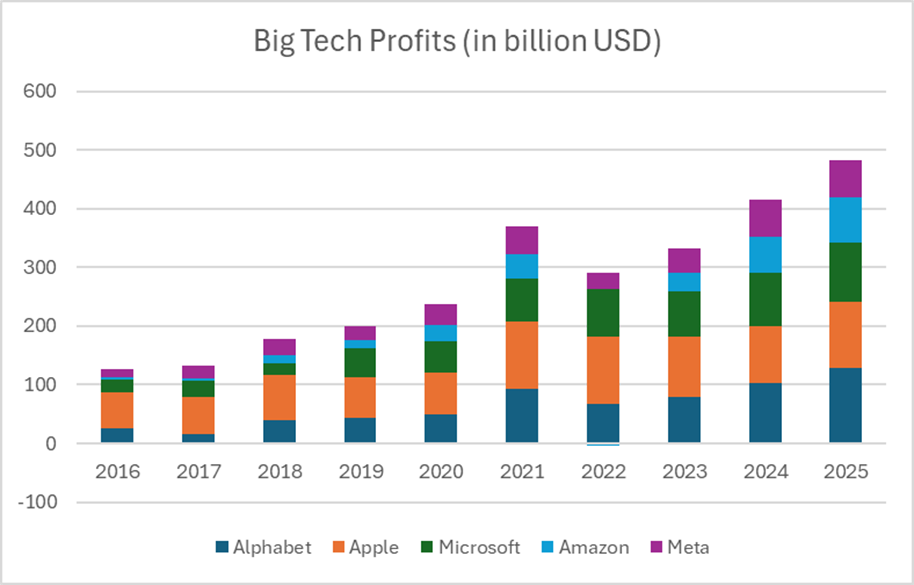
Source: traderfox.com and aktionaer.de
While the German economy has stagnated for six years, digital platforms have been increasing their profits to previously unheard-of levels. Google’s parent company Alphabet alone made 125 billion dollars in profit last year, roughly as much as Germany’s 40 largest listed corporations combined. The dominance of digital platforms does not remain without consequences. Due to their monopolies in their respective markets, which they defend through aggressive strategies, they enrich themselves at the expense of business customers and consumers. They leverage their technological advantages to charge inflated prices for their services and products. Growing economic dissatisfaction over affordability feeds resentment among the population and ultimately leads to a crisis of democracy and the rise of authoritarian rule, which relies on the increasing concentration of power in the economy and society. This essay analyses the situation from an economic perspective and discusses options for action to safeguard digital sovereignty.
Monopoly
Amazon’s rise to become the dominant force in online retail followed a straightforward plan. For a long time, the corporation made no significant profits but instead financed its growth through persistently low prices and cross-subsidized its own services. Merchants also benefited for a long time: the platform offered services that opened up new opportunities and reach, particularly for independent business owners.
But the euphoria did not last. In 2025, Amazon generated roughly 75 billion dollars in profit. In recent years, fees for merchants have been massively increased, and anyone who wants to remain visible in search results must purchase expensive advertising. If a product performs particularly well, Amazon promptly launches its own, cheaper variant. Because the corporation can monitor every movement on the platform, it finds it easy to exploit and abuse this market power.
These practices are under observation by various competition authorities. In the United Kingdom, for instance, trade associations have already filed damage claims, although the corresponding proceedings sometimes drag on for several years. Merchants are therefore largely defenceless against Amazon’s methods. With approximately more than 200 million Prime accounts worldwide, switching to other retail platforms is more painful for many than remaining within the Amazon ecosystem.
Google, in turn, earns a large share of its revenue from advertising. Several business practices have already been challenged in court. Google pays approximately 20 billion dollars annually to be pre-installed as the default search engine on Apple devices. Moreover, the company exploits its role as a platform to favour its own product search (Google Shopping) over competitors. Meanwhile, the quality of search results continues to decline; amid advertisements and sponsored results, one easily loses track of which links are even still normal. The economic value of this monopoly position: the profit from its search engine alone last year was estimated at roughly 70 billion dollars.
Meta secured its market power primarily through aggressive acquisitions: roughly 1 billion dollars for Instagram in 2012, and approximately 19 billion dollars for WhatsApp in 2014. In return, users encounter designs intended to be maximally addictive — with consequences that particularly burden the mental health of young people. Add to this hordes of scammers who swindle investors out of their money through dubious crypto schemes, and bot armies that destabilize our political system with fake news. Meta’s annual profit currently stands at approximately 60 billion dollars.
Many government agencies and businesses are now heavily dependent on Microsoft. The corporation sells not just office software, but an entire ecosystem. Small and medium-sized enterprises in particular find it difficult to switch: Microsoft creates a lock-in effect that grants the company considerable pricing power. Additionally, support for older products is frequently discontinued to force companies to switch to newer products. Annual profit last year: 100 billion dollars.
Apple has refined this logic even further. The concept is called “Walled Garden”: a closed, tightly interlocked ecosystem stabilized by brand loyalty and an almost religious consumer fetishism — yielding ever more profit. Last year it was 112 billion dollars.
Extraction
After the digital platforms had secured their monopolies, the second phase of their strategy began: extraction. Extraction means that the platforms slowly and gradually raise their prices while their services simultaneously deteriorate. For businesses and entrepreneurs, this manifests in higher fees for advertising on Google, Amazon, and Meta, rising fees in Apple’s App Store, and increasing costs for IT infrastructure and devices. Consumers pay directly with their data and their attention, but they too suffer from higher prices, because many companies pass the additional burdens on to their customers.
Moreover, the services deteriorate, for instance through a significant increase in advertising (Google, Meta, Amazon) or the absence of noticeable technical innovations (as is frequently the case with Apple). For consumers and businesses, these practices are often difficult to see through, and even when noticed, there are often no real alternatives. The platforms command a multitude of finely calibrated levers with which they keep users on their offerings. The power imbalance is enormous: the companies possess the data and have created veritable machines with their apps that can be conveniently deployed for manipulation.
As a consequence, the dominance of digital platforms contributes to the divergence in economic development between the United States and Europe in recent years: while the U.S. economy grows robustly, Europe’s economy appears increasingly weak. This divergence is particularly evident in productivity statistics.
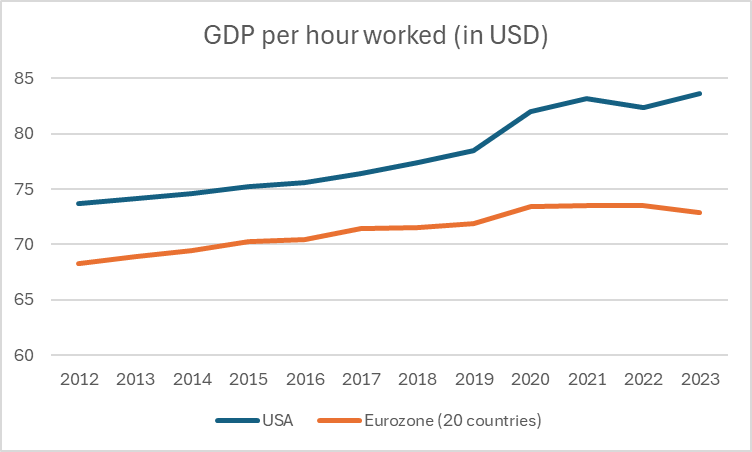
Source: OECD
Between 2012 and 2017, productivity — measured as GDP per hour worked — developed largely in parallel in the United States and the Eurozone. From 2018 onward, precisely at the moment when the profits of digital platforms began to rise noticeably, the productivity curve in the Eurozone flattened. While value added per hour worked in Europe has stagnated for several years, it continues to rise in the United States. A key reason for this is that the digital platforms increase their profits year after year, thereby contributing to the growth of gross domestic product in the United States.
But this development causes division not only between countries, but also within society. On one side stand those who benefit: engineers with in-demand technical skills, as well as a professional class of consultants, lawyers, and entrepreneurs who quickly advance into high salary ranges. In addition, there are shareholders who participate in the growth of the digital platforms.
On the other side stand those who bear the costs: people who lose jobs and economic independence or suffer under rising prices. This includes craftspeople and other small business owners who depend on advertising through Meta or Google or sell their products via Amazon. Equally affected are workers in precarious employment, particularly in creative industries whose foundations are eroded by collapsing advertising revenues, such as the cultural sector and journalism.
Furthermore, those already living under difficult circumstances are hit hardest, as they have scarcely any means to defend themselves against the practices of the digital platforms. This requires education, time, and financial resources — precisely what many people affected by poverty typically lack.
Even in the United States itself, people are not spared from this troubling development. While profits flow freely on Wall Street and in Silicon Valley, families are breaking apart elsewhere, and people flee into addiction or fall into the hands of conspiracy narratives and online cults with no end in sight.
Road to serfdom
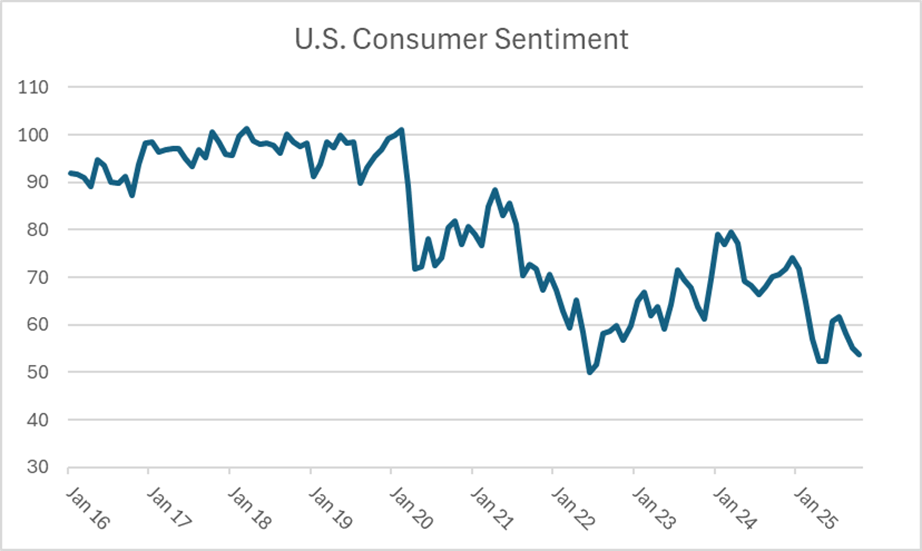
If the triumph of the digital platforms was a technological revolution, then it was one of the most joyless revolutions there ever was. After a high in the 2010s, consumer sentiment in the United States fell to a historic low of 50 points in June 2022 due to the shockwaves of the COVID-19 pandemic, the subsequent inflation, and the Russian war of aggression (the University of Michigan’s Consumer Index has existed since 1978). In March 2024, sentiment recovered to an index value of 79.4 points, but since then it has been declining again to a level of 53.6 points in October 2025.
While the election of Donald Trump briefly contributed to a brightening of consumer sentiment (74 index points in December 2024), disillusionment set in quickly after his inauguration (52.2 in April 2025 following the announcement of tariff policies). Sentiment did recover during the summer as it became clear that the tariff policies would only be enforced in a weakened form and many companies were hesitant to raise prices. However, it has since returned close to its historic low.
The most important factor behind poor consumer sentiment is certainly the continuing rise in prices and concerns about the future due to an uncertain global situation. But developments surrounding artificial intelligence also play a role. While excitement and the hope for a reshuffled deck of cards still prevailed after the release of ChatGPT in the fall of 2022, the mood has since shifted and more people fear losing their jobs or being replaced by machines. AI had the potential to break up existing power blocs — instead, it now threatens to further cement the market power of the platforms. Added to this are fears of a gigantic AI investment bubble that could drag the rest of the economy into the abyss.
Fear is spreading, and this fear generates resentment directed against a ruling elite that no longer represents people’s own interests, since it is primarily the digital platforms and their partners who benefit from the existing system. In the United States, this resentment has fueled the rise of Donald Trump, who is now systematically dismantling regulatory barriers for the digital platforms. Competition regulators are acting conspicuously cautiously, and mergers and acquisitions are reaching record levels once again. If this development is not rigorously controlled, further increasing market concentration and consequently rising prices loom. Moreover, a barely concealed form of corruption is emerging in some places: companies secure approval for mergers through donations for construction projects such as a new ballroom in the White House, or by firing well-known late-night show hosts such as Stephen Colbert and Jimmy Kimmel.
As a result of increasing market concentration, a global storm has been gathering for years that now threatens to engulf Europe as well. Far-right parties are gaining influence and coming to power, while the democrats are no longer able to manage the political challenges due to shifting parliamentary majorities. In light of the international situation and the pressure from autocratic rulers from abroad, a dysfunction of the political system is setting in that seems almost impossible to overcome. Authoritarian leaders are on the rise — and in alliance with the digital platforms, they would have the capability to establish a digital surveillance state. Welcome to Digital Dystopia.
A Way Forward
Platforms have shaped the history of global capitalism like hardly any other institution. The Greek agora, the Oriental bazaar, the Aztec tianguis, and the markets of China brought supply and demand together and, through binding rules, created an economic balance that contributed significantly to the rise of their respective civilizations.
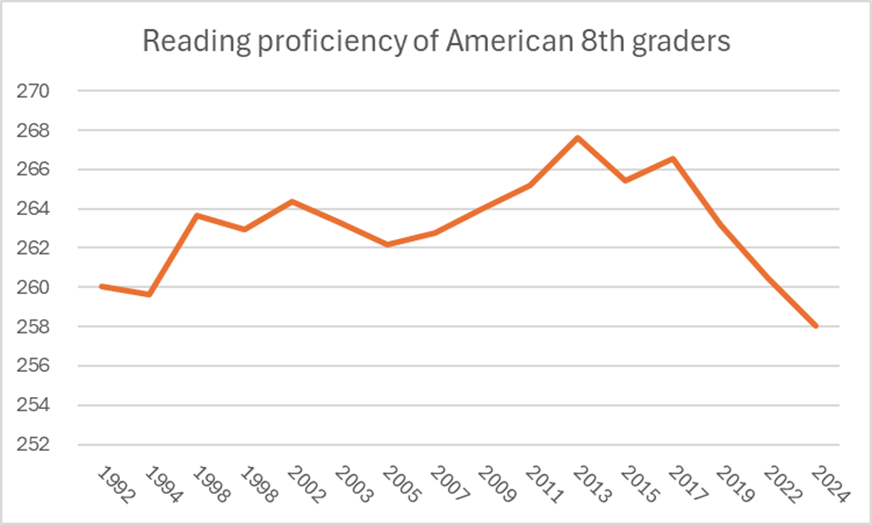
At the end of the 1990s, there was an almost boundless optimism about the internet, too. It was considered the engine of a new golden age that would promote freedom, prosperity, and democracy. These hopes, however, have not been fulfilled. In place of freedom and independence, monopolistic platform structures have emerged, and instead of a strengthening of democratic processes, a global rise of autocratic tendencies can be observed. Furthermore, the business models of many digital platforms promote addictive applications that are accompanied by a rise in mental illness and contribute to an alarming loss of fundamental cultural skills such as reading, writing, and arithmetic.
A future-oriented perspective therefore requires placing platforms at the center once again and regulating them in the spirit of their ancient predecessors. Specifically, platform operators should not be allowed to sell their own products on their marketplaces — or at the very least, only under strictly regulated conditions.
Like other modern platform markets and network infrastructures, such as in telecommunications, digital platforms should also be subject to binding and transparent rules. First steps in this direction already exist: the European Union’s Digital Markets Act aims at effective competition regulation of large platforms, while the Digital Services Act obliges platforms, among other things, to curb propaganda and harmful content.
However, the consistent implementation of these rules is being massively obstructed by the U.S. administration. Nor does additional competition from Chinese platforms offer a solution, since economic dependencies on China are already being politically instrumentalized today.
Europe’s digital sovereignty therefore includes no longer making itself vulnerable to blackmail by other power blocs. This encompasses building its own security and defence capabilities as well as diversifying global supply chains and reducing one-sided import dependencies on China. At the same time, Europe must — as already criticized in the Draghi Report — become more competitive and innovative again. Central to this is overcoming economic fragmentation within Europe through open markets and the removal of internal trade barriers, as well as an integrated capital market to better scale European innovations.
Beyond this, a fundamental rethinking is needed in European companies and administrations. Instead of reflexively relying on office software from Microsoft or Google, the offerings of European providers as well as open-source applications should be deliberately evaluated and consistently used. This would not only strengthen digital sovereignty but also promote innovation and competition within Europe.
Due to technological and geopolitical developments, humanity is heading toward a waterfall. We know that everything will change, but we do not yet know how. Either we work toward a planetary world order based on a finely tuned balance of power that respects the sovereignty of individual world regions, so that cultural diversity can continue to exist and flourish. Or we slide into a new imperial system in which great powers treat other world regions as colonies, exploit them through digital platforms, and systematically extract value. It is up to us to prevent the road to this digital dystopia.
by Benno Flügel